AMAZON · UX MANAGEMENT CASE STUDY · 2026
Building Amazon’s new internal Hiring Hub in under two months.
Leading four designers through an eight-week pilot to give hiring managers one clear view of candidates, tasks, and next steps.
Role · UX Manager, leading a team of four designers
Scope · Hiring manager experience, pilot strategy, cross-functional delivery
Outcome · 8% customer-satisfaction lift; 94% found the experience valuable
TL;DR
My team of 4 designers built a new and improved internal hub for hiring and interviewing activities. It replaced a complex, legacy recruiting tool with a new streamlined product that highlights priority hiring tasks and information, guiding users, and leading to a customer satisfaction rate that exceeded targets by 4% after rolling out to 5K hiring managers. It will be extended to 50K internal users in Q4 2026.
Context
Before 2026 at Amazon, hiring managers for corporate roles were stitching together internal and external candidate information across disparate systems. They were navigating legacy applicant-tracking tools built for recruiters, then creating their own ways to track, prioritize, and complete work outside of the system. The fragmented process slowed candidates down and left hiring managers unsure how to keep hiring on track. They were making inconsistent hiring decisions at scale at every stage, losing quality candidates, and sometimes hiring the wrong ones, leading to $700M annual cost to the business in hiring defects.
Recruiters also lacked visibility into the internal pipeline, meaning they were sourcing for roles that already had strong internal candidates. A senior designer had defined a three-year north-star vision for the hiring and interviewing experience; but when a pilot was greenlit on short notice, my team needed to turn that vision into something deliverable in less than 2 months.

✖️ Unguided experience lacking clear task hierarchy
✖️ Extraneous level of detail for Hiring Managers leading to cognitive overload
✖️ Minimal guardrails; ability to take actions outside of policy
The challenge
The project’s timeline and commitments were set before UX was involved: leverage an agile process to build a net-new recruiting experience from start to finish in eight weeks. Engineering was ready to build immediately, leaving no lead time for foundational alignment on scope or requirements. The original UX owner had rotated to another project, design resources reported into other managers, and decisions had to move fast without fragmenting the work.
My role
I managed the project from the UX side and led four designers resourced from other teams through planning and delivery. I built the delivery sprint schedule, mapped features to working plan, represented UX at twice-weekly project leads syncs, and drove the biweekly UX demos across leadership and stakeholders. I brought UX Research in to define validation plan, partnered with project leads on pilot scope and success criteria, coordinated adjacent teams that needed to link to or embed the experience, and provided feedback to keep the work aligned to the strategic north star and our target persona.

Approach
I started by setting rules of engagement: a ways-of-working framework that established how UX would collaborate, our delivery and share-out cadence, and the trade-offs we were explicitly accepting. Most notably, we deferred upfront research and planned to use the pilot group itself for in-depth interviews after launch. I then built the work-back plan, asking designers to review requirements, estimate their own scope, and secure commitment from both them and their managers.

We worked in two-week sprints: one week heads-down, an internal share-out, then a week of iteration, culminating in leadership review. With time for only three sprints before requirements freeze, I set up a weekly design review that brought the four designers and key stakeholders into the same critique space.
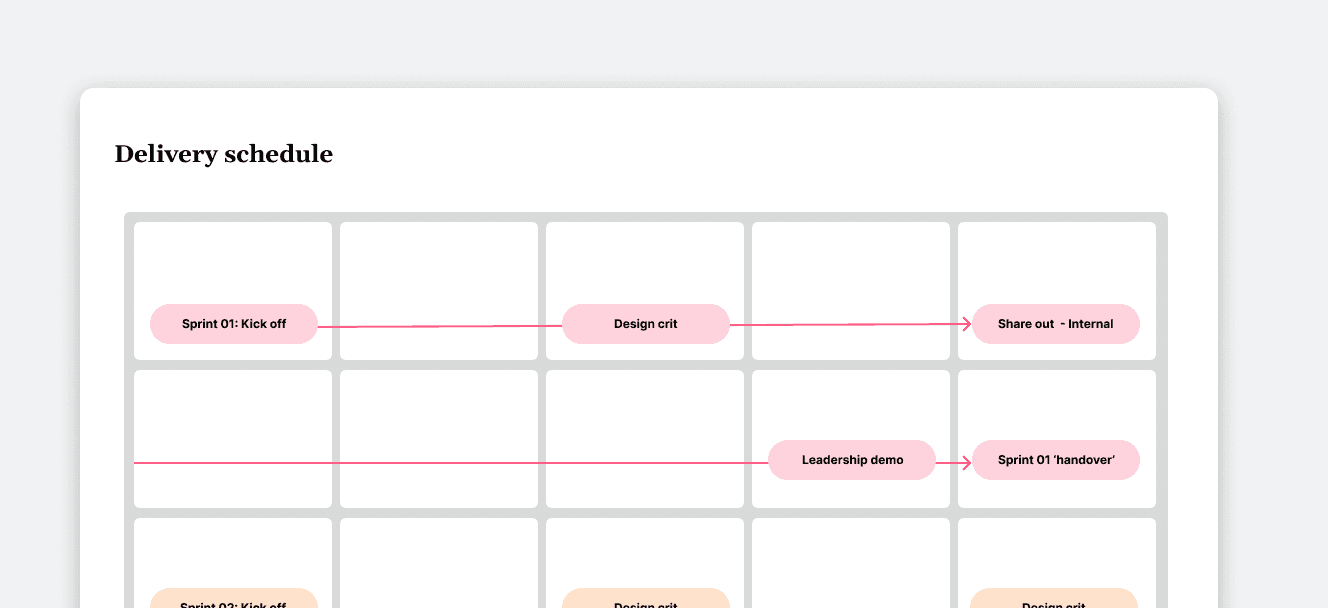
To keep the work from fragmenting, we used a single shared file as the source of truth and defined information architecture before breaking into feature-level work. The product strategy centered on clear, prioritized tasks for hiring managers: the highest-impact improvement we could credibly deliver in the pilot.

What we built
A new purpose-built home for hiring managers to see all of their job activity and upcoming tasks in one dedicated place. Accessible from their primary tool, Amazon A to Z, they could now see their open jobs, what progress was being made by recruiters, quickly review new candidates, see upcoming activities, and track their priority tasks more easily. A regular cadence tasks email helped keep them notified and focused on key information rather than having to search it across platforms.


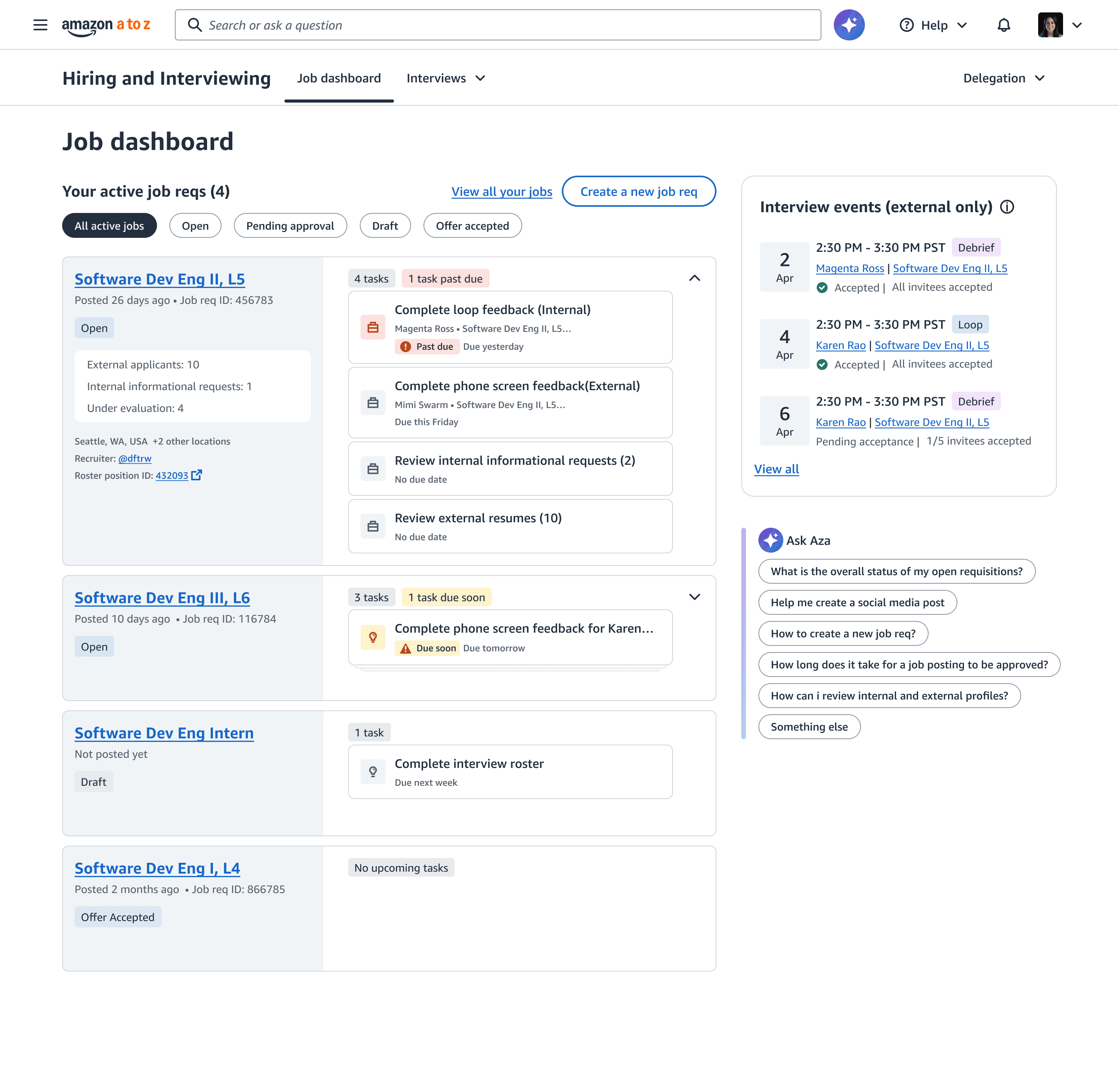


➕ Introduce tasks feature to guide users to priority actions
➕ Reduce detail and improve information hierarchy for clearer focus
➕ Reduce functionality to specific to user needs and implement system policy guardrails
➕ Improve notifications for more focused manager alerts
Outcome
We launched to a pilot group of 140 users in April 2026. Hiring managers reported efficiency gains from having one unified view of internal and external candidates with clear task prioritization, instead of juggling systems. Post-launch research used real hiring managers working with their real candidate data, making the qualitative findings more credible than synthetic testing would have been.
"Before this, I had to go into a completely different system to see [performance] scores. Now it's right there. I can go through 20 candidates in the time it used to take me to do 5." - Amazon Hiring Manager
The initial post-launch survey showed an 8% lift in customer satisfaction over baseline, with 94% of users finding the new experience valuable. The goal for the project overall was to increase Hiring Manager positive response rate from 80% to 85% on a regular cadence survey. The early success of the pilot work secured continued investment after being presented to three directors and one VP in Q2 2026. In June 2026, the new experience was extended to 5,000 additional Hiring Managers and maintained the positive response rate of 89%, exceeding the target by 4%. The program is continuing through 2026 where support for all interviewers at Amazon, roughly 140K active users.
Reflection
The central tension on this project was the lack of UX input into upfront timeline commitments and the agile methodology. With more runway, I would carve out dedicated time for strategic alignment and scope definition before delivery began, reducing rework when the timeline is already tight. I would also advocate for an all-team in-person workshop at kickoff to tackle foundational decisions together, so each subsequent sprint could move faster with more shared context.