AMAZON · UX MANAGEMENT CASE STUDY · 2025–2026
Rebuilding Amazon’s corporate career site across web and mobile.
Leading the UX direction for a new corporate candidate hub from early concept through mobile app and web launch.
Role · UX Manager · Team · 2 direct designers · Scope · Strategy, information architecture, cross-functional alignment
TL;DR
My team designed a new job-seeker experience as part of a migration to Amazon's new corporate site, solving user pain points with search and application tracking, and building the new career foundation for Amazon's 7M annual job applicants.

Context
Before 2025, engaging with Amazon as a job-seeker meant navigating a fragmented landscape. Role types, locales, subsidiaries, post-application communications, and employer-brand content all lived in disconnected properties. Amazon’s People Experience and Technology organization set out to unify this journey into one consistent web and mobile platform, aiming to improve profile completion, maintain organic traffic, candidate satisfaction, and application completion while laying groundwork for AI-powered role matching.
Examples of Amazon's varied external candidate-facing properties:


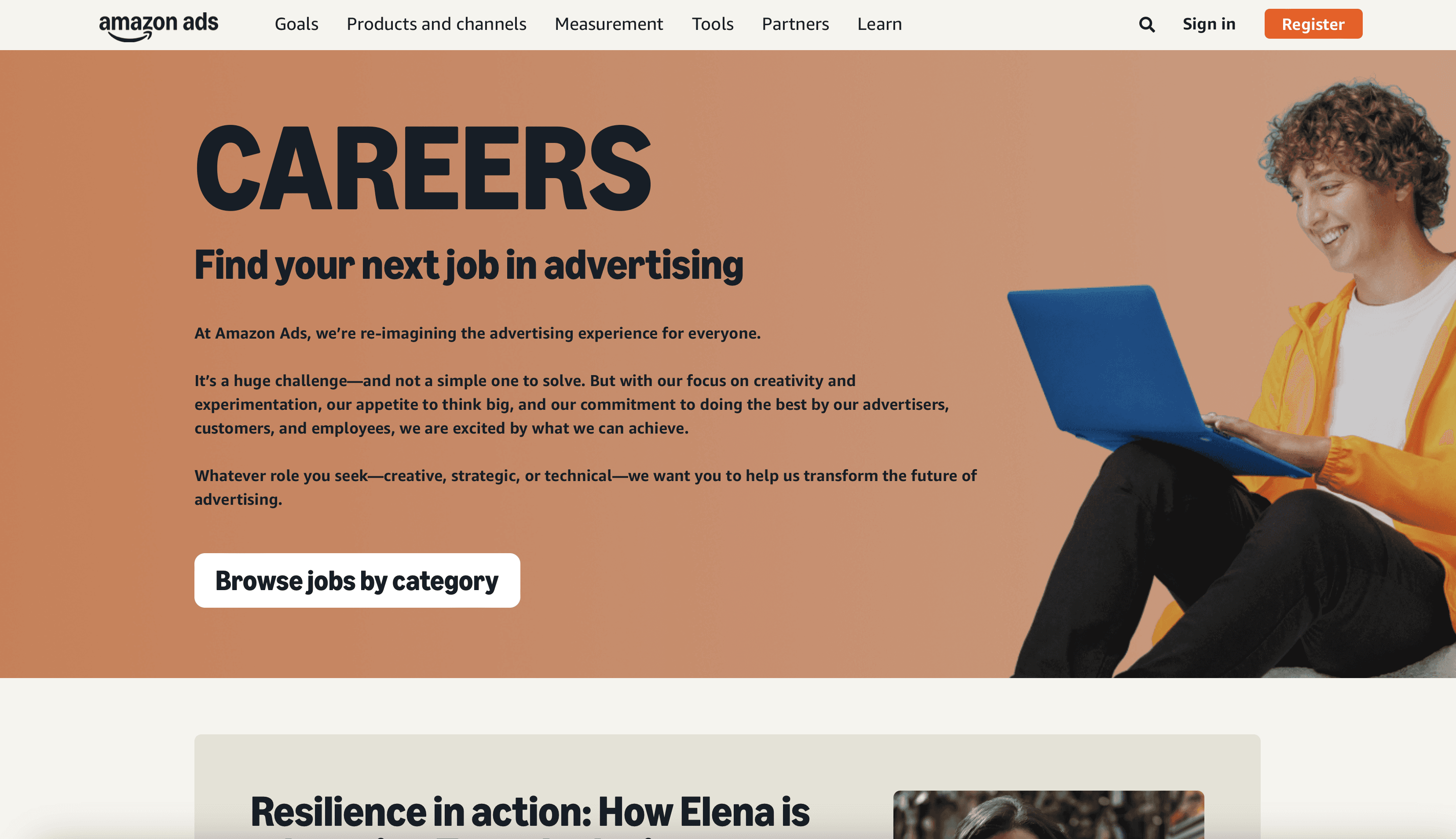


✖️ Legacy career site with dated visual design and branding
✖️ Different hiring sites spun up by different lines of business within Amazon leading to candidate confusion and inconsistent corporate voice
✖️ Hard to find jobs that match skills and interests
✖️ Search usability issues and long, complex job application form
✖️ Minimal post-application tracking leading to 'black hole' perception for candidates
The challenge
As part of this initiative, Amazon.jobs, the legacy career site I was responsible for, became a tenant of a new corporate site, Amazon's A to Z for Everyone. My team had to define the strategy for how career content should be integrated when different corporate properties, (news, benefits, onboarding and multiple jobs sites), all merged together, requiring thoughtful negotiation between stakeholders. Some headwinds: the central framework team was working far ahead of my team's roadmap, creating a mismatch in priorities; changing the domain and URL would lead to 20 years of search equity lost; all four product partners turned over in the first three months of the project, and the work required six months of alignment with more than 15 directors and VPs across partner organizations for this high profile initiative.
My role
I managed the UX team responsible for the job seeker experience within the new corporate site, leading two designers and acting as the bridge between the Jobs and the central framework and marketing teams. I influenced the strategic decisions for how to merge our jobs site identity into the corporate site, set priorities, delivery schedule, resource plan, and aligned direction with organizational leadership. In the first phase, I led the team to define interaction patterns and principles for the mobile app, which served as a pilot, and in the second phase made key improvements to the job-seeker experience for web. Throughout the 18 month project I led director and VP reviews, partnered with design leadership as priorities shifted, and guided the team through concept development when product management coverage was unavailable.

Approach
To meet the framework team's timelines, I directed my team into early concept development before product management was staffed, work that ultimately ended up defining the requirements for the job-seeker experience in the new site. I established twice-weekly design meetings with the framework team, co-defined research goals, and facilitated information-architecture sessions with employer marketing and central framework partners. I advocated for weaving our job seeker content throughout the site rather than isolating it in one section, (which would have been easier from a technical ownership perspective), and pushed back on short-term technical decisions that would have compromised the customer or brand experience, such as hard-coded pages.

What we built
The launch was deliberately phased. The A to Z mobile app arrived first in October 2025 as a focused pilot with job recommendations and a simple AI assistant meant to validate the technical architecture and release an on-the-go version of the career site targeted at students. The more comprehensive web platform is launching in stages through 2026, setting up the deprecation of the legacy career site and migration of ~16M of monthly visits to one new unified experience.
A mobile app designed for jobseekers on the go to with core job discovery and search functionality, job recommendations, and chatbot support.

A new flagship corporate site for Amazon focused on job discovery and personalized recommendations that brings all of Amazon's corporate entities into one experience.


➕ Updated to modern visual style, latest corporate branding, and employer value proposition
➕ Consolidated distributed hiring sites into one unified corporate career site
➕ Improved search and job discovery with personalized recommendations
➕ Improved usability in the application
➕ Adding post-application tracker and actions for improved visibility into the hiring process
Outcome
Phase 1: The mobile app launched as a pilot in October 2025, reaching half a million downloads, 42,000 monthly active users, and maintaining 72% application-completion rate, securing further investment to move forward with the web experience in 2026.
Phase 2: Launching soon. The web job-seeker experience is set to launch in September 2026, creating an updated, modern corporate hiring experience with robust feature improvements to help candidates find their perfect fit among Amazon's 1000s of open roles.
Reflection
At the start, my team was hesitant to begin substantive work before the roadmap and product-management coverage were resolved. In hindsight, I would push the work further ahead of the framework team’s pace from day one, developing a sharper, earlier point of view on the site’s role and how jobseeker content should live within it.