AMAZON · DESIGN MANAGEMENT CASE STUDY · 2025–2026
Building an AI-powered evaluation suite for Amazon’s interviewers.
Leading two designers across definition of five AI-assisted tools that support interviewer judgment without replacing it.
Role · UX Design Manager · Team · 2 designers · Scope · AI workflows, interviewer platform, portfolio coherence
TL;DR
My team created designs for 4 new AI-powered candidate evaluation tools to improve interview feedback and evaluation quality in the hiring process and reduce time-intensive manual effort for Amazon's 200K interviewer population.
Context
Amazon’s hiring decisions depend on the judgment of more than 200K certified interviewers and roughly 10K Bar Raisers. Yet the surrounding process was heavy: people organized notes, prepared questions, compiled feedback, and reconstructed interview loops before debriefs. Bar Raisers alone spent an estimated 88,000 hours annually on administrative preparation. The product team saw an opportunity to bring AI assistance into every stage of evaluation without displacing the human judgment that protects Amazon’s hiring bar.

✖️ Interviewing resources patchy and distributed across internal wikis, training modules, and offline docs leading to inconsistent use.
✖️ Challenge to capture quality interview notes and stay present in conversation with candidates
✖️ Variable quality of written interview feedback
✖️ Manual, time-intensive process to analyze themes across candidate feedback and arrive at a well-calibrated interview decision
The challenge
Each tool had its own product and engineering constraints and timelines, and was powered by its own AI model. UX served as the connective tissue, defining how the experiences could work as one coherent system. The persistent design question was at what point does helpful AI becomes too directive. Throughout the solutions the system needed to provide better questions, structure, and synthesis without suggesting ratings or recommendations that could undermine interviewer judgment or bias the process.
My role
I managed the two designers responsible for hands-on feature design across the suite and the redesign of the platform that housed it. I partnered with product leadership on strategic direction, coached the team on where the value was for interviewers, pushed back on technical constraints when necessary, and used critique to pressure-test the boundary between support and decision-making within the features.

“Danica encouraged me to think beyond the immediate scope and consider the bigger picture of what value we are delivering to customers. […] She shared her thought process and inspired me to explore different approaches. ” - Sr. UXD
Approach
Rather than treating this as five feature launches, we organized the work around the arc of an interview loop. Designers set up structured reviews across PM and UX partners to surface conflicts early, and built holistic usability testing into project plans so in-flight features could be tested together. I stayed closely connected to PM, TPM and Eng to anticipate changes, then coached the design team through the recurring question: does this AI interaction help an interviewer think more clearly, or does it start to tell them what to decide? We navigated this through ongoing discussions and debate with stakeholders as use cases emerged and stress-tested it in prototypes.
What we built
5 new features for AI-assisted evaluation workflows in Amazon's corporate recruiting tool:
Interview Prep Assistant · Generated tailored interview plans and competency questions, moving preparation from offline notes into a consistent, system-supported workflow.

Interview Transcription · Let interviewers stay present with candidates while preserving an accurate record for every downstream decision.

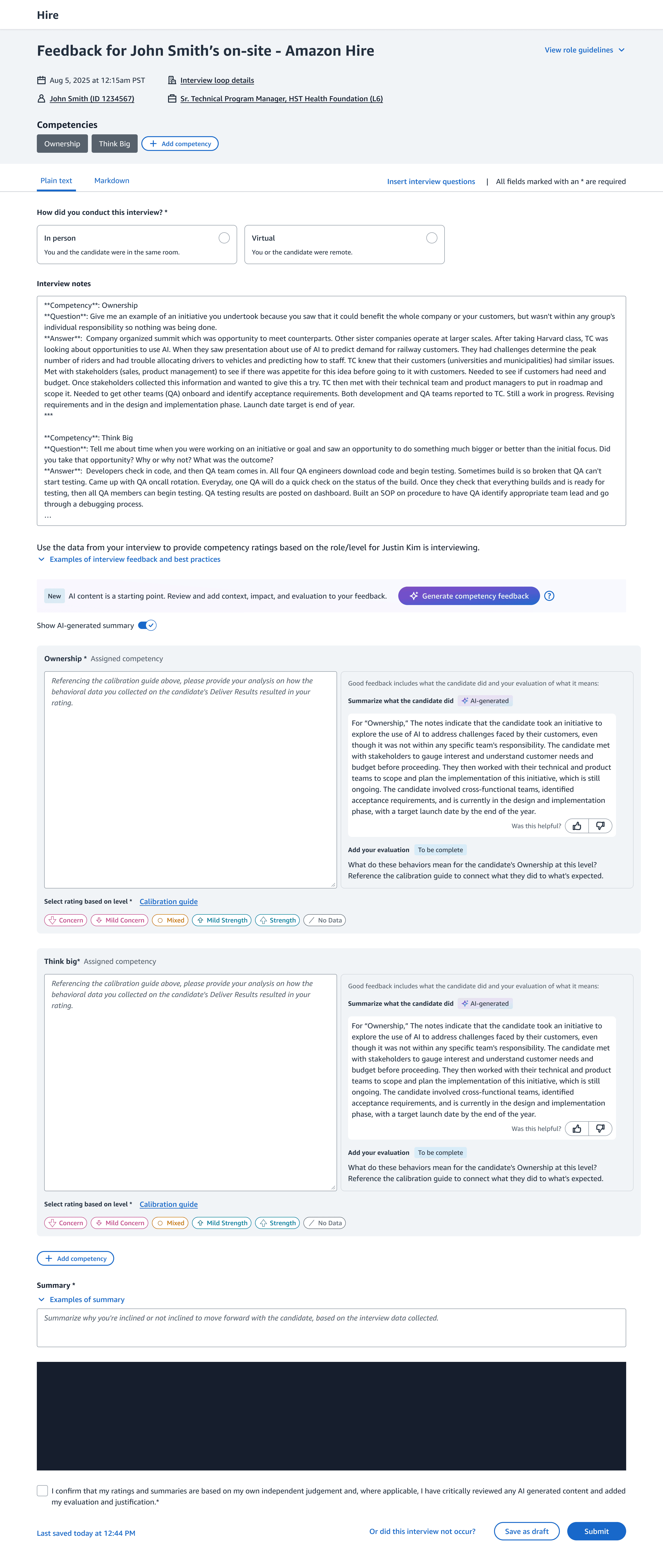
Interview Feedback Builder · Structured raw notes against Amazon’s writing guidelines while requiring interviewers to add their own evaluative judgment and final rating.
Debrief Prep Experience · Surfaced strengths, gaps, mixed signals, and follow-up questions for Bar Raisers — always traceable to original source feedback and never a hiring recommendation.

Interviewer Workspace · Replaced a legacy recruiter-oriented landing page with a purpose-built destination for every interviewing task, from feedback submission to training requirements.


➕ Interviewing guidance and resources embedded in AI support tools in-context
➕ Interviewers focus on candidates instead of note-taking
➕ Improved writing tools with AI for higher quality feedback
➕ Themes and discussion points automatically synthesized across all interview feedback providing a clearer picture of the candidate and driving better hiring decisions with reduced manual effort
Outcome
Interviewer Workspace became Amazon's recruiting platform's most-visited feature after launch, with strong adoption and retention across a 500,000+ business-user base. Interview Transcription covered 6,296 interviews in its first two Early Adopter months, with more than 99% reliability and strong interviewer sentiment: 88% said it was easy to use and 81% reported meaningful time savings.
“I really appreciate the tool and think it's an excellent addition to Amazon's interview process. […] I quite like being able to free up my hands and the relevant part of my brain to focus more on the candidate, the interview, and their answers to my question. Bottom line: hugely appreciate this function. Awesome job!” - Amazon interviewer
The Debrief Prep Experience piloted with Bar Raisers in Q1 2026, leading to expansion toward general availability for Amazon’s 10K Bar Raisers. Early feedback on the Feedback Builder also showed gains in analytical depth, coherence, and projected time savings.
Reflection
This set of projects were being developed ad-hoc as they were prioritized quarterly. My design team did as much as possible to treat them as a holistic initiative and mitigate any conflicts in decision-making across teams, however if we had had more capacity and known what was coming up front, we could have used this as an opportunity to push for and establish formal interaction patterns and guardrails for AI components in the recruiting tool set. Instead, the work of aligning design patterns and standards stayed as manual processes to maintain consistency over the course of the projects.